An Eye for an Eye: The Cycle of Retribution and the Burning of the Shenandoah Valley
This talk will look at “The Burning,” the systematic Union campaign in the Fall of 1864 to cripple the Shenandoah Valley’s role as the “Breadbasket of the Confederacy, as well as the road to the Burning – the escalating cycle of “eye for an eye” retribution and hardening hearts that led up to the devastation of “Red October.”
Bio: Terry Heder
Terry is a writer and historian who served as the Director of Interpretation, Education, and History for the Shenandoah Valley Battlefields Foundation for 15 years, overseeing the organization’s interpretive, education, historical, visitor services, partnership, museum, library, archives, and print and digital communications programs throughout the eight-county Shenandoah Valley Battlefields National Historic District, including work at 20 major battlefields and related historic sites. During the Civil War Sesquicentennial, he served as regional coordinator for Sesquicentennial planning in the Valley, helping to plan, present, and promote over 200 programs in the Valley.
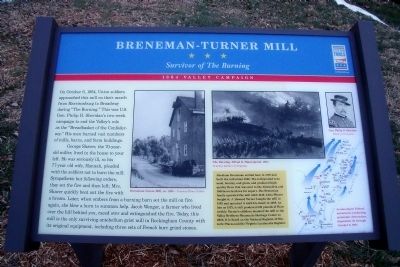
Breneman-Turner Mill
Survivor of The Burning
— 1864 Valley Campaign —
Inscription. 
George Shaver, the 70-year-old miller, lived in the house to your left. He was seriously ill, so his 77-year old Wife, Hannah, pleaded with the soldiers not to burn the mill. Sympathetic but following orders, they set the fire and then left; Mrs. Shaver quickly beat out the fire with a broom. Later, when embers from a burning barn set the mill on fire again, she blew a horn to summon help. Jacob Wenger, a farmer who lived over the hill behind you, raced over and extinguished the fire. Today, this mill is the only surviving antebellum grist mill in Rockingham County with its original equipment, including three sets of French burr grind stones.
(sidebar)
Abraham Breneman settled here in 1770 and built the mill about 1800. The mill ground corn meal, hominy, and grain, and produced high-quality flour that was sent to the Alexandria and Baltimore harbors for export. The Breneman family operated the mill until 1849, when Shaver bought it. J. Howard Turner bought the mill in 1933 and operated it until his death in 1988. As late as 1973, it still produced 500 pounds of flour weekly. Turner’s children donated the mill to the Valley Brethren-Mennonite Heritage Center in 2003. It is listed on the National Register of Historic Places and the Virginia Landmarks Register. …
Location. 38° 31.508′ N, 78° 52.519′ W. Marker is near Edom, Virginia, in Rockingham County. Marker is at the intersection of Turners Mill Lane and Breneman Church Road (Virginia Route 778), on the right on Turners Mill Lane. Touch for map. Marker is at or near this postal address: 5036 Turners Mill Lane, Harrisonburg VA 22802.
Breneman-Turner Mill Historical Marker Database
 Shenandoah Valley Civil War Round Table SVCWRT
Leave a comment